
August Jobs Report: What Softening Employment Means for Island Rates and TimingCanada’s August 2026 employment report (September 4 release) showed a soft month for jobs — and British

Dated: July 17 2026
Views: 1091
Royal LePage released its national House Price Survey and Market Forecast for the second quarter of 2026 on July 14. The short version: after a slow start to the year, buyers began returning in May, but caution is still the defining mood. That pattern holds true here in the Comox Valley, and the local numbers tell a clearer story than the national headline.
Here is what we are watching, and what it means if you are thinking about buying or selling this year.
Across Canada, the aggregate price of a home was $814,900 in the second quarter, down 1.4 per cent from a year ago and essentially flat compared to the first quarter, up just 0.2 per cent (Royal LePage House Price Survey, Q2 2026). The country's two most expensive markets softened the most: Greater Vancouver fell 4.5 per cent year over year to $1,164,100, and the Greater Toronto Area fell 4.6 per cent.
The Bank of Canada's key lending rate has held at 2.25 per cent since October 2025. Royal LePage forecasts the national aggregate price to finish 2026 up 2.0 per cent over the fourth quarter of last year, while Greater Vancouver is projected to end the year down 3.5 per cent.
The recurring theme in Royal LePage's regional commentary is pricing discipline. In Greater Vancouver, managing broker Randy Ryalls put it plainly: well-priced homes are drawing multiple offers because the value is clear, while overpriced listings are being largely ignored. That is the same dynamic we are seeing on the ground here.
Vancouver Island runs on its own cycle, so we look to the Vancouver Island Real Estate Board (VIREB) and to Royal LePage's local Comox Valley reporting rather than to the national average.
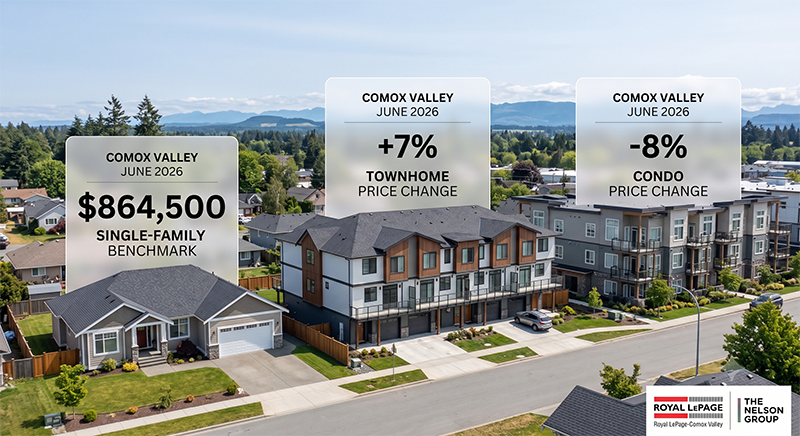
The benchmark price of a single-family home in the Comox Valley was $864,500 in June 2026, down 1 per cent year over year (VIREB, June 2026). Board-wide across Vancouver Island, the single-family benchmark was $790,800. For comparison across the Island: Parksville-Qualicum sat highest at $929,500, up 3 per cent, while Campbell River was $680,900 and Nanaimo was $816,400.
Looking at Comox Valley single-family activity specifically, 67 homes sold in June, down about 8 per cent from a year earlier, with an average sale price of $904,480, down roughly 3 per cent year over year. Active single-family listings were 198, and the sell-to-list ratio was 62 per cent (Royal LePage Comox Valley Market Conditions, June 2026, statistics supplied by VIREB). Note that the benchmark and the average measure different things: the benchmark tracks a typical home over time, while the average is pulled up or down by whichever homes happened to sell that month.
Two segments moved in different directions. Comox Valley condo apartments averaged $394,994 in June, down about 8 per cent year over year, with active listings down sharply. Townhomes averaged $607,539, up about 7 per cent, with a sell-to-list ratio above 100 per cent, a sign that competition for well-located attached homes is real.
The local read from the June Royal LePage Comox Valley report describes a lukewarm, patient market. There is very little single-family inventory priced below $600,000, so first-time buyers are turning to townhomes, half-duplexes, and manufactured homes. When lower-priced homes finally sell, those owners move up into the $750,000 to $900,000 range, which is where most of the volume sits. Rising gas and food costs are adding to the hesitation.
VIREB's Chief Executive Officer, Jason Yochim, summarized the Island-wide mood the same way: buyers are taking a measured, wait-and-see approach, well-priced properties still attract interest and occasional multiple offers, and buyers are more price-sensitive at the higher end. Homes priced above what the market will support are sitting longer.
Price to the market, not to last year's peak. The evidence from both the national survey and the local June data points the same way: realistic pricing is drawing offers, and sometimes competing ones, while ambitious pricing is being passed over. Presentation and an accurate list price are doing the heavy lifting right now. We build every listing price from current Comox Valley comparables, not from a national headline.
You have time and choice, which is a genuine advantage. Inventory is steady, and higher-priced homes in particular are negotiable. The pressure point is the entry level: single-family homes under $600,000 are scarce, so if that is your range, townhomes and other attached options deserve a serious look. For anyone downsizing, the softer condo segment is presenting some good opportunities.
Market averages describe the whole valley. They do not price your specific home, your street, or the property you are hoping to buy. If you would like a clear, no-pressure assessment based on current local data, reach out and we will walk you through it.
Travis Nelson Personal Real Estate Corporation Nikki Nelson The Nelson Group Royal LePage-Comox Valley (CV)
Benchmark and average prices are useful for identifying trends over time. They do not indicate the value of any individual property and do not account for differences between neighbourhoods or property types. This post is general market information, not a property-specific valuation or financial advice. For a home-specific analysis, contact us directly. REALTOR® and MLS® are trademarks owned or controlled by The Canadian Real Estate Association and identify real estate professionals who are members of CREA and the quality of services they provide.

Choosing who represents your sale or purchase is one of the most consequential decisions you'll make on the North Island. Travis and Nikki Nelson built The Nelson Group to make that decision an easy o....
August Jobs Report: What Softening Employment Means for Island Rates and TimingCanada’s August 2026 employment report (September 4 release) showed a soft month for jobs — and British
BCREA Nowcast: Vancouver Island Soft Spot: What It Means for Comox ValleyBCREA’s latest Nowcast (August 31, 2026) shows British Columbia’s economy rebounding after a shaky start to the
Royal LePage released its national House Price Survey and Market Forecast for the second quarter of 2026 on July 14. The short version: after a slow start to the year, buyers began returning in May,
As we move into 2026, the Canadian housing market feels very different than it did just a year or two ago. After a period defined by rapid rate increases, uncertainty, and hesitation, the market is
 Information should be deemed reliable but not guaranteed, all representations are approximate, and individual verification is recommended. Copyright ©2026 All rights reserved.
The trademarks REALTOR®, REALTORS® and the REALTOR® logo are controlled by The Canadian Real Estate Association (CREA) and identify real estate professionals who are members of CREA. The trademarks MLS®, Multiple Listing Service® and the associated logos are owned by CREA and identify the quality of services
provided by real estate professionals who are members of CREA. Used under license.
Show More...
Information should be deemed reliable but not guaranteed, all representations are approximate, and individual verification is recommended. Copyright ©2026 All rights reserved.
The trademarks REALTOR®, REALTORS® and the REALTOR® logo are controlled by The Canadian Real Estate Association (CREA) and identify real estate professionals who are members of CREA. The trademarks MLS®, Multiple Listing Service® and the associated logos are owned by CREA and identify the quality of services
provided by real estate professionals who are members of CREA. Used under license.
Show More...
 All information deemed reliable but not guaranteed. All properties are subject to prior sale, change or withdrawal. Neither listing broker(s) or information provider(s) shall be responsible for any typographical errors, misinformation, misprints and shall be held totally harmless. Listing(s) information is provided for consumer's personal, non-commercial use and may not be used for any purpose other than to identify prospective properties consumers may be interested in purchasing. The data relating
to real estate for sale on this website comes in part from the Internet Data Exchange program of the Multiple Listing Service. Real estate listings held by brokerage firms other than the Nelson Group may be marked with the Internet Data Exchange logo and detailed information about those properties will include the name of the listing broker(s) when required by the MLS. Copyright ©2026 All rights reserved.
Last Updated: September 9, 2026 3:23 PM UTC
Show More...
All information deemed reliable but not guaranteed. All properties are subject to prior sale, change or withdrawal. Neither listing broker(s) or information provider(s) shall be responsible for any typographical errors, misinformation, misprints and shall be held totally harmless. Listing(s) information is provided for consumer's personal, non-commercial use and may not be used for any purpose other than to identify prospective properties consumers may be interested in purchasing. The data relating
to real estate for sale on this website comes in part from the Internet Data Exchange program of the Multiple Listing Service. Real estate listings held by brokerage firms other than the Nelson Group may be marked with the Internet Data Exchange logo and detailed information about those properties will include the name of the listing broker(s) when required by the MLS. Copyright ©2026 All rights reserved.
Last Updated: September 9, 2026 3:23 PM UTC
Show More...